
Indian Diet Plan for Weight Loss: A Doctor-Approved Guide
Key Takeaways
- A sustainable Indian diet plan works with your regional cuisine, not against it — no foreign superfoods required
- Portion control, plate composition, and meal timing matter more than cutting out rice, roti, or ghee
- Indian vegetarian diets can absolutely support healthy weight loss when protein is prioritised
- The biggest dietary risks for Indians are refined carbs, sugar-sweetened chai, and oversized portions — not traditional food
- A doctor-reviewed plan accounts for your metabolism, medical conditions (PCOS, thyroid, diabetes), and food culture
Forget the Keto Craze. Indians Need an Indian Plan.
Open any weight-loss article written for a global audience and you will find the same tired advice: eat avocados, drink almond milk, give up rice, live on quinoa and kale. For most Indians, this is not just impractical — it is unsustainable. Indian households revolve around dal, roti, rice, sabzi, curd, and chai. A diet plan that ignores these is a diet plan that will fail.
The good news: traditional Indian food, eaten intelligently, is one of the most powerful weight-loss tools available. You do not need to import a Western diet; you need to eat an Indian diet like an Indian doctor would recommend — with the right portions, the right composition, and the right timing.
This guide walks you through exactly that.
First Principles: What Actually Matters
Before any meal plan, understand these non-negotiables. Every evidence-based Indian weight-loss plan is built on them.
1. Total Calories Still Matter — But Quality Matters More
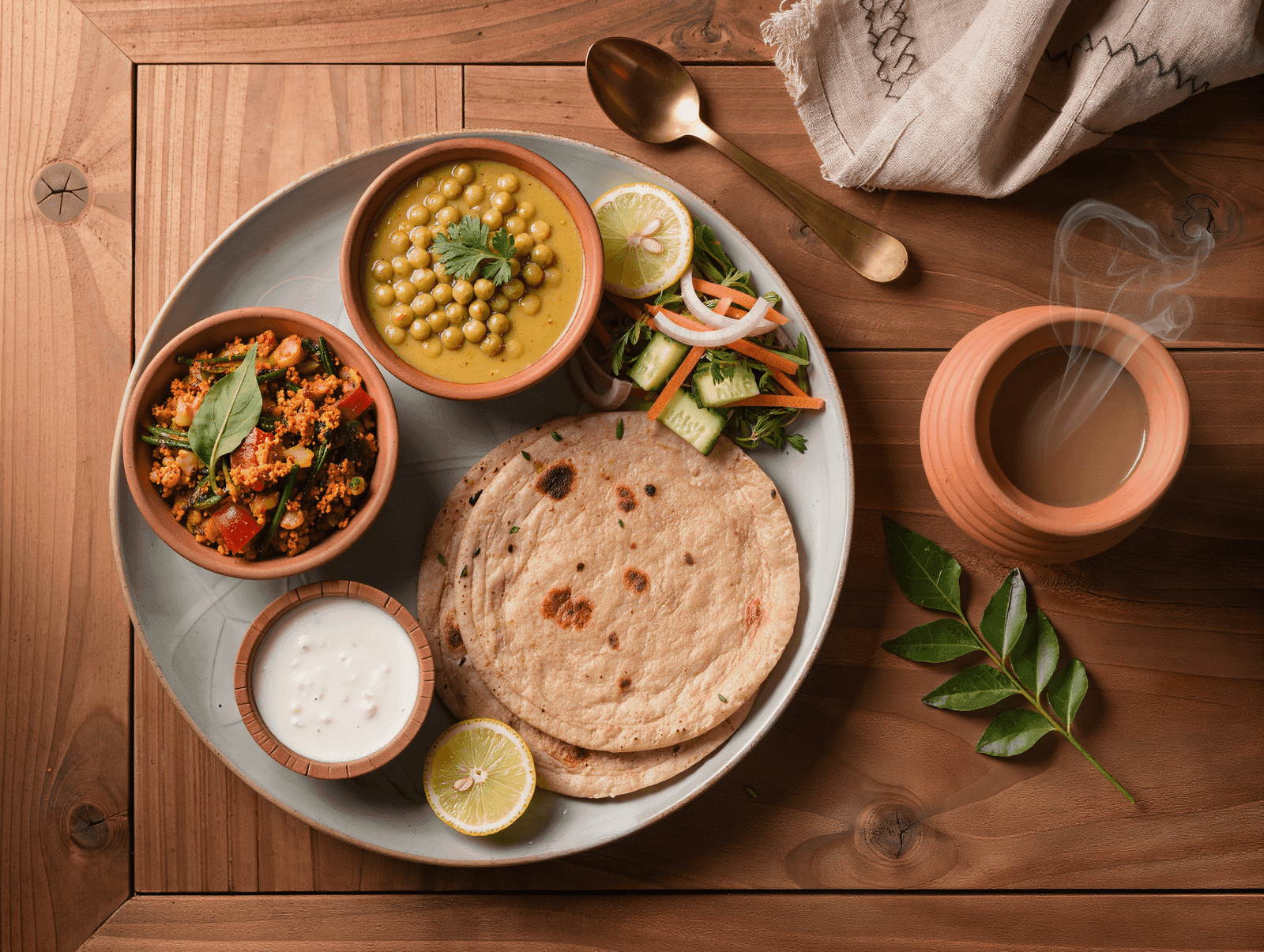
You cannot out-train a 3,000-calorie-a-day habit. But two people eating the same number of calories can have dramatically different outcomes depending on what those calories are. A thali of whole-wheat roti, dal, sabzi, and curd will leave you full for 4–5 hours. The same calories from a plate of pav bhaji with buttered pav will leave you hungry in 90 minutes and trigger a sugar spike that promotes fat storage.
2. Protein Is Non-Negotiable
The single biggest nutritional gap in most Indian diets — especially vegetarian — is inadequate protein. Protein increases satiety, preserves muscle during weight loss, and has the highest thermic effect of any macronutrient (meaning your body burns more calories digesting it). Target 1.2–1.6 g of protein per kg of body weight for sustainable weight loss. For a 70 kg adult, that is 84–112 g of protein daily.
3. Indians Need Stricter Carb Discipline Than Most
South Asians are genetically predisposed to store more visceral (belly) fat at lower weights and are far more sensitive to refined carbohydrates. White rice, maida roti, biscuits, chai with two spoons of sugar, bakery items, and street food all spike insulin sharply and promote fat storage. This does not mean "no carbs" — it means the right carbs in the right portions.
4. Meal Timing Helps
Eating your last meal 2–3 hours before bed and maintaining a consistent breakfast, lunch, and dinner schedule helps regulate insulin, sleep, and hunger hormones. Late-night eating, even of healthy food, tends to promote weight gain in Indian bodies.
The Doctor-Approved Indian Plate: Composition
For any main meal (lunch or dinner), aim for this composition — adjusted to your hunger and body size:
- Half the plate: vegetables and salad — sabzi, green leafy vegetables, salad, raita. Fibre, volume, micronutrients.
- One quarter: protein — dal, chana, rajma, paneer (in moderation), sprouts, egg, chicken, or fish. For vegetarians, combine lentils with dairy or grain to form complete proteins.
- One quarter: complex carbohydrate — 1 or 2 multigrain or whole-wheat rotis, OR a fist-sized portion of brown rice, hand-pounded rice, millets (ragi, bajra, jowar), or parboiled rice.
- 1 tsp of healthy fat — ghee, mustard oil, groundnut oil, or sesame oil used in cooking. Fat is not the enemy; deep-fried food is.
- 1 katori of curd or buttermilk — probiotics, protein, satiety.
Simple rule: your plate should look like a rainbow, not beige.
A Sample Day: Vegetarian Weight-Loss Plan (~1,500 kcal)
This is illustrative — your actual calorie target depends on your age, weight, height, activity level, and medical conditions. A doctor or dietician should individualise it.
Breakfast (7–9 am, ~350 kcal)
- 2 vegetable besan chillas with mint chutney or 1 bowl moong dal chilla + 1 boiled egg (if non-veg)
- 1 cup chai with milk, no sugar or 1 tsp jaggery
- 1 small bowl seasonal fruit (papaya, guava, apple)
Mid-Morning Snack (11 am, ~100 kcal)
- 1 handful roasted chana + 5–6 almonds or 1 katori cucumber and carrot sticks with hung-curd dip
Lunch (1–2 pm, ~500 kcal)
- 2 multigrain or jowar/bajra rotis
- 1 katori dal (moong, masoor, or toor)
- 1 katori sabzi (palak, methi, lauki, bhindi — not aloo-based)
- 1 katori curd or buttermilk
- Salad — cucumber, carrot, onion, tomato, lemon
Evening (4–5 pm, ~150 kcal)
- 1 cup green tea or black coffee, no sugar
- 1 small bowl sprouts chaat or 1 small bowl roasted makhana
Dinner (7–8 pm, ~400 kcal)
- 1 katori brown rice or 1 multigrain roti
- 1 katori rajma / chana / paneer bhurji / tofu
- 1 katori mixed-vegetable sabzi
- 1 katori salad
Post-Dinner (optional, ~50 kcal)
- 1 cup warm haldi milk (unsweetened) or chamomile tea
Non-Vegetarian Additions
If you eat non-vegetarian food 3–4 times a week, your protein goals become much easier. Good options:
- Grilled, tandoori, or steamed chicken (120–150 g) — avoid butter chicken and heavy cream gravies
- Fish — rohu, pomfret, salmon, mackerel, sardines (especially for omega-3)
- Egg whites in addition to one whole egg daily
- Lean mutton occasionally (1–2 times a month), not weekly
What to Reduce, Not Ban
Complete restriction usually leads to binge cycles. Instead, reduce these strategically:
- White rice — switch to brown, hand-pounded, parboiled, or millets. Keep small portions on social occasions.
- Maida — cut naan, paratha made from maida, biscuits, bakery items. Switch to whole-wheat and multigrain.
- Sugar — this is the single biggest lever for most Indians. Chai with 2 sugars × 4 cups daily = over 150 kcal of pure sugar daily, or 4.5 kg of fat a year.
- Deep-fried snacks — samosa, pakora, bhajiya, puri. Reserve for festivals.
- Sweets — barfi, jalebi, rasgulla, gulab jamun. Keep for specific occasions, not daily.
- Packaged juices and soft drinks — even "100% fruit juice" spikes sugar rapidly. Whole fruit is always better.
Hydration, Chai, and the Silent Sugar Problem
The average Indian adult consumes 3–5 cups of chai daily. If each cup has 1.5 tsp sugar, that is 15–25 tsp of sugar a day from chai alone — without counting anything else. This is one of the easiest places to cut calories without reducing any food. Try:
- Reducing to 1 tsp sugar, then ½, then none
- Switching to jaggery (marginally better glycaemically, not miraculous)
- Green tea, masala tea without milk, or black coffee between chai rounds
Drink 2–3 litres of plain water daily. Thirst is frequently mistaken for hunger.
When This Plan Is Not Enough
A well-structured Indian diet plan is enough for many people, but not all. You may need medical help if:
- You have been eating cleanly for 3+ months and not losing weight
- You have PCOS, thyroid dysfunction, or insulin resistance (read our PCOS weight-gain guide)
- Your BMI is above 30 or you have comorbidities like prediabetes or hypertension
- You have tried and failed multiple diets (see why diets fail)
Medical weight management can address the biological factors — insulin resistance, hormonal imbalance, slowed metabolism — that no meal plan alone can fix.
The Bottom Line
You do not need a foreign diet to lose weight. You need an Indian diet eaten with discipline, medical awareness, and cultural honesty. Keep your rotis, keep your dal, keep your ghee. Lose your sugar, your maida, your oversized portions, and your liquid calories.
If you would like a plan built specifically around your metabolism, lifestyle, regional cuisine, and medical history, speak to a doctor. Before your call, you can estimate your starting calorie budget with our calorie calculator, and if you have a condition like PCOS or thyroid, our condition-specific pages explain what to expect. At NuvaHealth, we connect you with NMC-verified doctors who understand Indian food and Indian bodies — and build weight-management plans around both.
Frequently Asked Questions
Can I lose weight eating rice and roti?+
Yes. You do not need to eliminate rice or roti — you need to control portions (1 katori rice or 2 rotis per meal), prefer whole grains (brown rice, multigrain, millets), and balance your plate with protein, vegetables, and healthy fats.
Is a vegetarian diet good for weight loss in India?+
Absolutely — but only if protein is prioritised. Most Indian vegetarians under-eat protein. Include dal, chana, rajma, paneer, sprouts, curd, and eggs (if you eat them) at every main meal to make vegetarian weight loss work.
How many calories should I eat to lose weight as an Indian?+
It depends on your age, weight, height, activity, and medical conditions. As a rough guide, many Indian adults lose weight healthily at 1,400–1,800 kcal/day, but a doctor or dietician should individualise your target.
Should I give up chai to lose weight?+
No — but cut the sugar. Chai with 2 sugars × 4 cups daily adds over 150 kcal of pure sugar, which is the equivalent of 4.5 kg of fat a year. Reducing or eliminating sugar in chai is one of the highest-impact dietary changes Indians can make.
Ready to start your journey?
Connect with a licensed doctor who specialises in weight management. Private video consultation from home.
Start Your Assessment